Corporate catering and institutional catering get lumped together a lot. They shouldn’t be. When you’re feeding employees at an office, a bad lunch means some grumbling and a complaint email. When you’re feeding students at a school, the parents find out. When you’re feeding patients at a hospital, the dietary mistake might actually have clinical consequences.
The stakes are different. The regulations are different. The audiences can’t just walk to a restaurant if they don’t like the food. And in Saudi Arabia, institutional catering is a growing market that most catering companies haven’t seriously addressed because they’re focused on the corporate and events segments where the margins are more obvious.
We think that’s a gap worth filling.
Schools — where the parents are the real client
School catering in Saudi Arabia is changing. Private international schools in Riyadh have been running meal programmes for years, but the quality and nutritional standards have varied wildly. Some schools have proper in-house kitchens with qualified chefs. Others have a contract with whoever submitted the cheapest bid and the results show up in lunchboxes that come home untouched.
What’s shifting is parental expectation. Saudi parents — particularly at mid-to-high-tier private schools — are paying attention to what their children eat at school in ways they didn’t ten years ago. Nutritional awareness is higher. Social media means a bad school lunch gets photographed and shared. And schools are responding by looking for catering providers who can deliver child-appropriate meals with documented nutritional standards rather than just “food that fills them up.”
The practical challenges of school catering are specific. Kids are picky. The menu needs to be nutritious without being something that 80% of the students refuse to eat. Allergen management is critical because you’re dealing with children who might not be able to articulate what they’re allergic to. Lunch windows are short — 30 minutes is typical — which means service speed matters. And the academic calendar creates a demand pattern unlike any corporate contract: term time at full volume, school holidays at zero.
That on-off pattern is why schools benefit from working with a caterer who already runs long-term institutional contracts and can absorb the seasonal volume swings through their broader client base rather than treating each school as a standalone operation.
Universities — campus logistics at scale
University catering in Saudi Arabia is a different beast. You’re feeding thousands of students across a campus that might span several square kilometres, with dining halls, faculty lounges, student unions, and satellite buildings that all need service at different times.
The age group is different from school catering. University students are adults making their own food choices. They want variety, speed, and value. They’ll compare your campus cafeteria to the restaurants on the commercial strip outside campus, and they won’t be charitable about it.
Menu diversity matters enormously at the university level. Saudi universities have increasingly international student bodies — Gulf, African, South Asian, Southeast Asian, European exchange students. A single-cuisine menu alienates most of the campus. You need a rotation that cycles across Saudi, international, fusion, and lighter options, and it needs to change frequently enough that students who eat on campus five days a week aren’t bored by Wednesday.
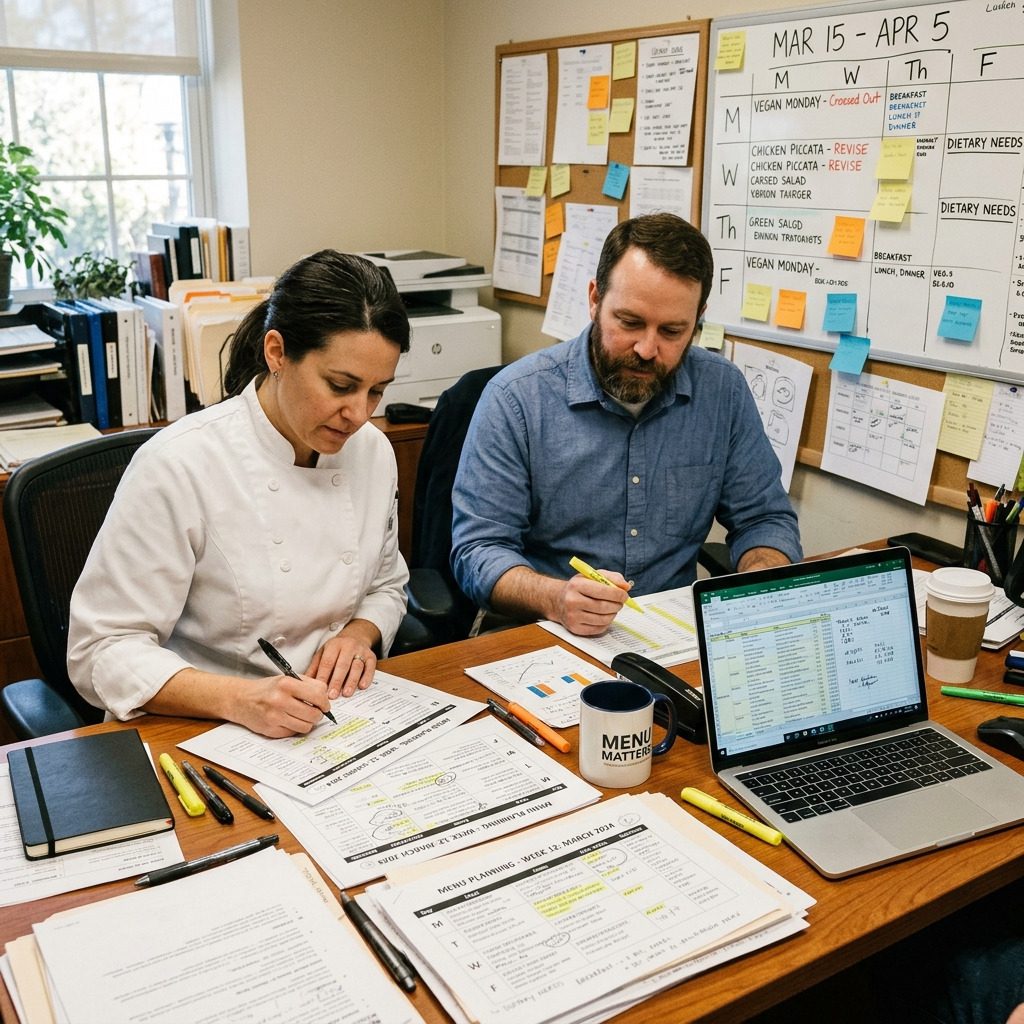
Our upcoming guide on menu planning at scale covers rotation design, dietary accommodation, and the feedback systems that keep menus relevant. The principles apply to campus dining just as much as corporate cafeterias.
The other university-specific challenge is the academic calendar. Semesters at full capacity. Exam periods with irregular attendance patterns. Summer sessions with reduced numbers but still requiring service. Mid-year breaks where the campus is half-empty but staff and maintenance crews still need feeding. A caterer who only knows Monday-to-Friday corporate rhythms will struggle with this.
Healthcare — where dietary management becomes clinical
Hospital and healthcare facility catering is the most demanding institutional category, and honestly, it’s the one where getting it wrong has the most serious consequences.
Patient meals aren’t regular meals with a patient label on them. They’re prescribed. A cardiac patient has sodium restrictions. A diabetic patient has carbohydrate targets. A post-surgical patient might be on a liquid diet transitioning to soft foods. A paediatric patient has entirely different portion sizes and nutritional requirements than an adult. Each tray that leaves the kitchen needs to match a specific dietary order for a specific patient. Get it wrong, and you’re not just serving a bad lunch — you’re potentially interfering with treatment.
Then there’s the staff feeding side. Hospital staff work 12-hour shifts with unpredictable break times. They eat when they can, not when the cafeteria schedule says they should. A catering programme for hospital staff needs extended service hours or — more practically — boxed meals that can be grabbed and eaten during a 15-minute window between patient rounds.
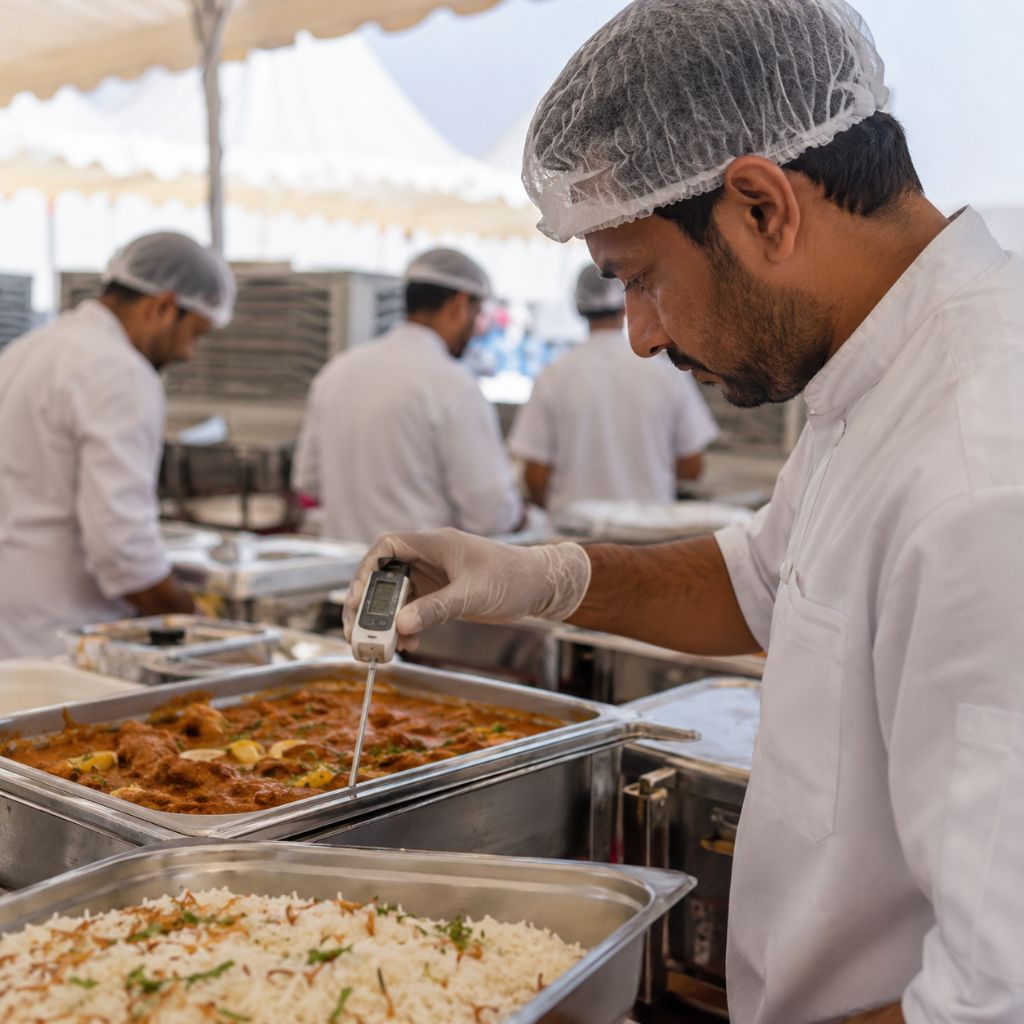
SFDA compliance in healthcare catering carries additional scrutiny. Hospital food safety inspections are more frequent and more detailed than standard commercial kitchen inspections because the patient population is medically vulnerable. Our food safety guide covers the SFDA framework — but healthcare adds layers on top of that baseline that standard corporate caterers aren’t set up for.
What institutional clients should look for in a catering provider
The evaluation criteria for institutional catering aren’t identical to corporate. Here’s what matters more in this space.
Volume consistency across irregular schedules. Institutional calendars — academic terms, hospital shift patterns, school holidays — don’t follow the predictable Monday-to-Friday pattern of office catering. Your provider needs demand forecasting systems that handle variability without overproduction or shortages.
Nutritional competence, not just menu creativity. Can the caterer work with a nutritionist or dietitian to design meals meeting specific nutritional targets? For hospitals, this is mandatory. For schools, it’s increasingly expected. For universities, it’s a competitive differentiator that attracts students and satisfies parents.
Age-appropriate menu design. A menu designed for corporate professionals doesn’t transfer to a primary school. Kids won’t eat it. Similarly, elderly patients in long-term care have different texture and dietary needs than university students. The caterer needs to design for the specific population, not repurpose their corporate menu with smaller portions.
Compliance track record with institutional audits. Government and institutional clients run more rigorous audits than private corporate clients. Ask the caterer specifically about their experience with institutional inspections — Ministry of Education requirements for school catering, Ministry of Health requirements for healthcare facilities. If they’ve never faced those audits, they may not be ready for them.
The institutional market in Saudi Arabia is growing
Saudi Arabia’s education sector is expanding — new schools, new universities, new training centres under the Human Capability Development Programme. Healthcare is expanding too — new hospitals, specialised clinics, rehabilitation centres. Each of these facilities needs a feeding programme that meets institutional standards, not just corporate ones.
For caterers, this is a growth market. For institutions looking for providers, the challenge is finding a caterer who understands the difference between corporate and institutional feeding. There are plenty who can feed an office. Fewer who can feed a school, a university, and a hospital to the standards each one requires.
Avala operates under Leylaty Hospitality Group, which has been running hospitality operations in Saudi Arabia since 1948. The Central Production Unit is designed for high-volume institutional-scale production. The compliance infrastructure is built for environments where audits happen regularly and standards aren’t negotiable.
Discuss institutional catering requirements with Avala’s contracts team.